Open Plan Living NZ: Costs, Consent & Design for Auckland Homes

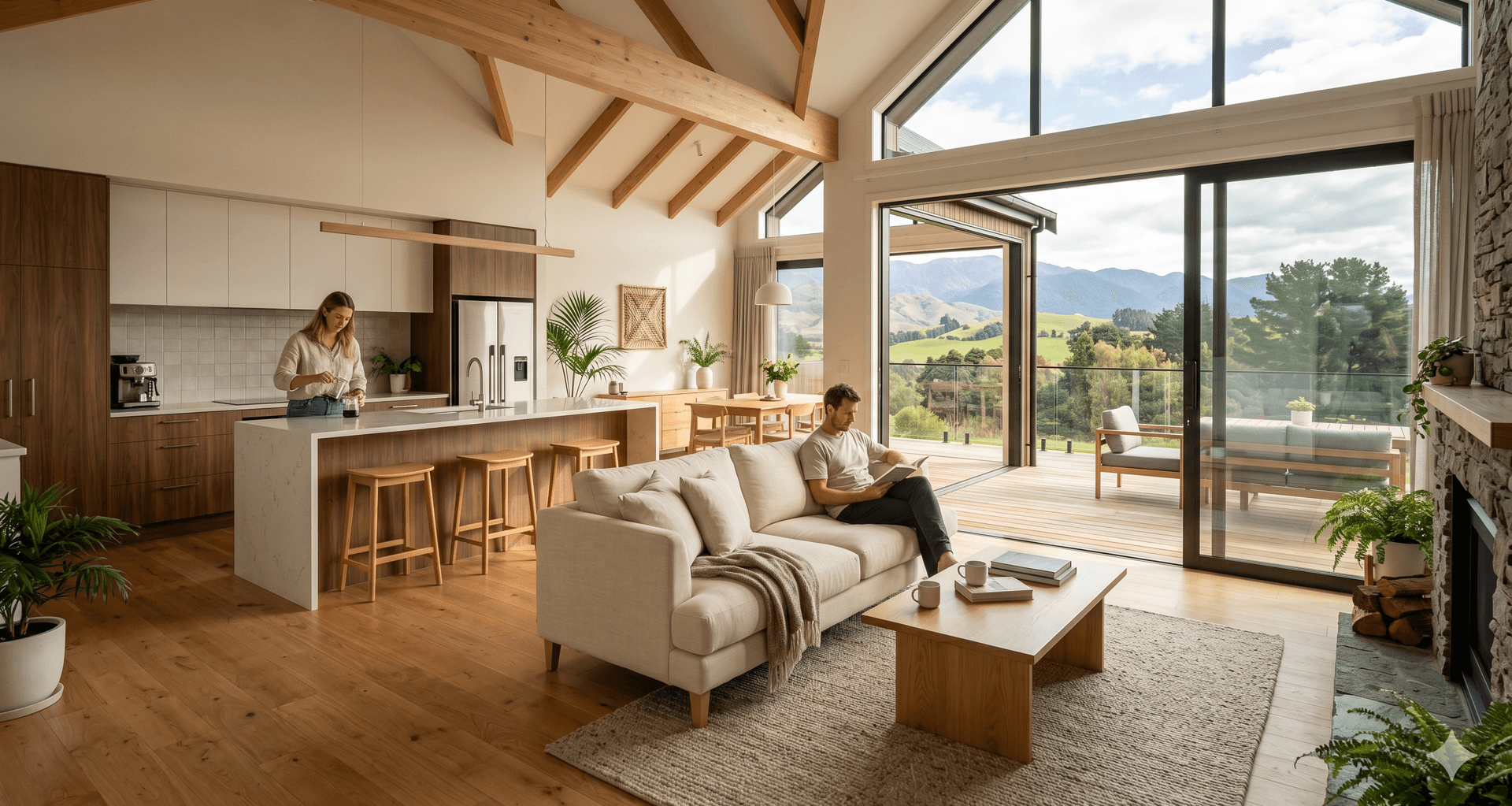
That wall between your kitchen and lounge — you've been staring at it for years. You know exactly what the house would feel like without it. More light, more space, kids visible from the bench while you cook, the whole back of the house breathing again. The idea isn't complicated. Getting there, though, requires more than a sledgehammer and a weekend.
Open plan living has become the default layout expectation for New Zealand homeowners — particularly in Auckland, where older housing stock means thousands of perfectly good homes are still carved up into small, enclosed rooms that made sense in the 1950s and make very little sense now. Whether you're working with a pre-war villa in Grey Lynn, a 1970s brick-and-tile in Papatoetoe, or a 1990s weatherboard in Albany, the process of opening up a home follows the same fundamental logic: understand the structure, confirm consent, design intentionally, and budget honestly.
Here's how we approach it — and what you actually need to know before the walls come down.
Why Auckland Homeowners Are Opening Up Instead of Moving
The Auckland property market has done something useful for renovation demand: it's made moving prohibitively expensive. Real estate fees, the price gap between where you are and where you want to be, and the sheer friction of uprooting a household have pushed thousands of homeowners toward a different question — not "should we move?" but "how do we make this home work better?"
Opening up the ground floor is usually the first answer. It's the single renovation that changes how a home feels most dramatically without adding a single square metre of floor area. Natural light penetrates further. Rooms that felt claustrophobic become workable. The kitchen stops being a separate utility and becomes the social centre of the house — which, in practice, is how most Kiwi families actually use it anyway.
For older Auckland homes specifically, the gains are real. Pre-1940 villas in Ponsonby and Mt Eden were designed with a narrow central hallway and rooms off both sides — a layout that kept heat in individual spaces in an era before central heating, but now just creates a series of dark boxes. The bones of those homes are often excellent. The layout is the problem.
Sound familiar? You're not alone. This is the most common starting point for the home renovations we do across Auckland every year.
Is Your Auckland Home a Good Candidate?
Not every home opens up equally, and the answer depends less on your taste and more on what's holding your ceiling up. This is the part most design inspiration content glosses over.
The wall you want to remove is either load-bearing or it isn't — and that single fact determines most of your budget and timeline.
Load-bearing walls carry structural weight from above: floor joists, roof loads, upper storey framing. They run perpendicular to the floor joists and, in single-storey homes, often sit directly above a foundation or beam. Non-load-bearing walls (also called partition walls) are just room dividers. They carry no structural load. Removing them is relatively straightforward.
In the 1960s and 70s bungalows common across South and West Auckland — Papatoetoe, Henderson, Manurewa — the wall between the kitchen and dining room is frequently load-bearing. We've opened up dozens of these homes. In older Grey Lynn and Ponsonby villas, it varies considerably depending on whether the home has been modified before and how the original framing was constructed. In 1990s homes in Albany or Hobsonville, internal partition walls are more often non-structural — but not always.
The only way to know for certain is to have a qualified structural engineer or Licensed Building Practitioner (LBP) inspect the wall before a single thing is touched. This isn't optional advice. It's the starting point.
Quick tip: Walls running parallel to the ridge of your roof and perpendicular to the floor joists are more likely to be load-bearing. Walls running the same direction as the joists are often partition walls. But identifying load-bearing status without professional assessment is guesswork — don't make expensive decisions based on it.
Also worth checking before you get too excited: does the wall contain any plumbing or electrical services? In many Auckland homes — particularly those that have been modified incrementally over decades — the wall you want to remove has a power point on one side or a waterline running through it to a bathroom above. None of this is a dealbreaker. It just affects cost and complexity.
The Consent Question: When You Need It and When You Don't
One of the most Googled questions about open plan renovations in NZ is whether you need a building consent to remove a wall. The answer is: it depends entirely on the wall.
Under Schedule 1 of the Building Act 2004, removing a non-load-bearing internal wall that contains no bracing elements, is not a fire separation wall, and is not a masonry wall does not require building consent. This is covered under Exemption 11 of MBIE's guidance on building work that doesn't need consent.
If the wall is load-bearing? Consent is required. Full stop.
Removing a load-bearing wall requires a building consent application to Auckland Council, structural engineering drawings signed off by a Chartered Professional Engineer (CPEng), and inspection at key stages of the build. Auckland Council typically processes consent applications within 20 working days, but realistically budget 4–6 weeks from application to approval when you factor in preparation time and any requests for further information.
Our full building consent guide walks through the process in detail — including what documents you need to prepare and how to avoid the common delays that stretch timelines out.
One more thing worth flagging: even if consent isn't legally required, all building work must still comply with the Building Code. Removing a non-load-bearing wall without consent doesn't mean you can skip bracing requirements or leave exposed wiring. The work still has to be done right.
What Does an Open Plan Renovation Actually Cost in Auckland?
This is where most content is either vague or outright useless. Let's be specific.
The cost range for opening up an Auckland home varies enormously based on one primary factor: whether the walls being removed are structural or not.
Non-structural wall removal
If your wall is a simple partition — no load-bearing function, no bracing elements, no plumbing — removal itself is typically in the $4,000–$8,000 range. That includes demolition, disposal, making good the ceiling, floor, and any electrical relocation. Add painting and finishing and you're looking at $8,000–$15,000 total for a clean, finished result. A modest but genuinely transformative spend if the bones are right.
Load-bearing wall removal with structural beam
This is where budgets shift substantially. Removing a load-bearing wall and installing the structural beam required to carry the load costs $15,000–$35,000 depending on span length, beam specification, and what else gets disturbed in the process. Add consent fees ($5,000–$12,000 for a standard Auckland residential consent), engineering, and the associated finishing work, and a single load-bearing wall removal in an Auckland home commonly lands between $25,000 and $45,000 all-in.
We had a client in West Harbour last year who wanted to remove the wall between their kitchen, dining, and living areas — two walls in total, one of which was load-bearing. The full scope came to $38,000, including engineering, consent, beam installation, new flooring to unify the space, and a completely reconfigured kitchen layout. The transformation was significant. They gained a connected, light-filled space that changed how the whole family used the house.
Full open-plan conversion with kitchen remodel
If opening up the floor plan also triggers a kitchen renovation — which it almost always does, since removing a wall between the kitchen and living area typically requires relocating cabinetry, plumbing, or appliances — the total project budget runs $60,000–$130,000 depending on kitchen specification and the extent of structural work involved.
Our free feasibility report is a good starting point if you're not yet sure what scope makes sense for your home, and our kitchen renovation cost calculator can help you get a rough sense of the kitchen component specifically.
Design: Making Open Plan Actually Work
Removing a wall doesn't automatically produce a great open plan space. We've seen plenty of homes where walls came down and the result was just a large, undefined room that nobody quite knew what to do with. Good open plan design is about creating zones — not erasing them.
"The biggest mistake we see in open plan renovations is treating the whole space as one room. It's actually three rooms — kitchen, dining, and living — that happen to share the same air. Each zone needs its own identity through lighting, flooring, and furniture placement. When you get that right, the space feels both expansive and intimate at the same time." — Dorothy Li, Design Manager, Superior Renovations
Flooring is one of the most powerful zoning tools available, and one of the most underused. Running the same engineered timber throughout unifies the space visually and makes the whole home feel larger. A subtle material transition — tile in the kitchen zone shifting to timber in the living zone — can define areas without walls. We often pair this with pendant lighting over the dining table and task lighting under kitchen cabinets to reinforce each zone's function.
Structural beams, where they're required, don't have to be hidden. In a recent Remuera project, we exposed the LVL beam and made it a design feature against the white-painted GIB ceiling — the industrial contrast worked beautifully in what was otherwise a classic villa interior.
Acoustics: the honest conversation
Here's what most open plan content skips: it gets noisy. A fully open kitchen, dining, and living space means that rangehood noise, television audio, and conversation all share the same acoustic environment. For families with teenagers and small children simultaneously, this matters.
The solutions aren't complicated — soft furnishings, rugs on hard floors, upholstered seating, curtains on large glazed openings — but they need to be factored into the design from the start. Acoustic rugs on engineered timber floors, in particular, make a measurable difference and are far cheaper to plan for upfront than to retrofit later.
Heating and cooling
Large open volumes need to be factored into any heating specification. A heat pump sized for the old lounge won't adequately heat a combined kitchen-dining-living space. This is particularly relevant in older Auckland villas, where the original 2.7m+ stud heights mean even more cubic volume to condition. EECA's guidance on home energy efficiency is worth reviewing before finalising your heating specification.
The Kitchen as the Heart of the New Layout
In an open plan home, the kitchen can no longer hide. It's visible from the living area, from the dining table, and often from the outdoor deck. That visibility changes everything about how it needs to be designed.
Islands and peninsula benches become the social pivot point — the place where guests congregate, where kids do homework, where meals get served and conversations happen. Getting the island dimension right is non-negotiable: too narrow and it feels cramped; too wide and it blocks circulation. We typically recommend a minimum 900mm clear walkway on all working sides, and a minimum 40mm stone or composite benchtop overhang if seating is planned.
"When the kitchen opens up to the rest of the house, finishes matter far more than they did before. You're not just choosing a kitchen — you're choosing a surface that reads from the sofa. That's why we always start open plan kitchen designs by thinking about what the cabinetry looks like from ten metres away, not just standing in front of it." — Alison Yu, Designer, Superior Renovations
Our kitchen renovation service covers the full scope — from structural integration with your open plan layout through to cabinetry, benchtops, appliance specification, and lighting design. We work from our design studio at 16B Link Drive, Wairau Valley, and can walk you through material options in person.
Indoor-Outdoor Flow: Opening Up Beyond the Back Wall
Auckland's climate makes indoor-outdoor connection genuinely useful for about nine months of the year. The open plan renovation conversation, for many homeowners, extends to the back of the house as well — replacing a solid wall with stacker doors or a large sliding glazed opening that connects the living area to a deck or patio.
This is where the scope can grow quickly. Removing an external wall to install bifold or stacker doors is almost always consent-required work — it involves weathertightness, structural modification, and changes to the building envelope. But the result — a living space that flows directly onto an outdoor entertaining area — is one of the most popular upgrades we do, and one of the most consistently satisfying for Auckland homeowners.
If your outdoor space also needs work, combining the open plan interior renovation with an outdoor extension or deck build in a single project typically saves 15–20% on overall costs compared to running them as separate projects. Tradies are already on site, consent can often be consolidated, and the design is unified from the start. Our landscaping and outdoor renovation team can scope both simultaneously.
Frequently Asked Questions
Do I need a building consent to remove a wall in my NZ home? It depends on the wall. Under Schedule 1 of the Building Act 2004, removing a non-load-bearing internal wall that is not a bracing element, fire separation wall, or masonry wall does not require building consent. However, removing a load-bearing wall always requires consent, a structural engineer, and Auckland Council approval. If you're not certain which type of wall you have, get an LBP or CPEng to assess before touching anything.
How much does it cost to remove a wall in Auckland? A non-structural wall removal typically costs $4,000–$8,000, rising to $8,000–$15,000 when you include finishing (paint, flooring, electrical). A load-bearing wall removal with structural beam installation runs $15,000–$35,000 for the structural work alone, plus $5,000–$12,000 in consent fees. Total all-in cost for a load-bearing wall removal in Auckland commonly lands between $25,000 and $45,000.
How do I know if my wall is load-bearing? Walls running perpendicular to floor joists are more likely to be load-bearing. In older Auckland villas and bungalows, walls running front-to-back down the centre of the house are often structural. The only way to know for certain is to have a qualified structural engineer or Licensed Building Practitioner inspect the wall — don't guess on a decision this significant.
What are the downsides of open plan living? The main practical downsides are acoustics, heating, and loss of privacy. Open spaces carry sound easily — rangehood noise, TV audio, and conversation all share the same environment. Large open volumes are also harder to heat efficiently. These aren't reasons to avoid open plan, but they should inform your design decisions around soft furnishings, rugs, acoustic panels, and heating specifications.
Does an open plan renovation add value in Auckland? Generally yes — open plan layouts are strongly preferred by Auckland buyers, and a well-executed renovation typically adds more in perceived value than it costs, particularly in older homes where the existing layout feels dated. The caveat is quality: a poorly finished open plan space can work against you. Design and execution matter as much as the structural change itself.
Opening up an Auckland home is one of the most rewarding renovations you can do — and one of the most consequential to get wrong. The structural decisions are permanent, the consent process is non-negotiable where required, and the design work needs to be deliberate. Done well, it changes how a family lives in their home every single day.
If you're thinking about opening up your floor plan and want to understand what it would actually take for your specific home, book a free consultation with our team. We'll walk you through the structural assessment, design options, consent requirements, and realistic budget — before you commit to anything.