Joana Bover's quiet rebellion against brightness. Why one of lighting's most influential voices designs against glare and excess.
Written by
08 February 2026
•
6 min read

In Australia, those questions feel particularly urgent. Designers are working with expansive glazing, strong daylight and outdoor spaces that function as true extensions of the home. Light here is abundant and often unforgiving. The challenge is no longer how to add more of it, but how to soften it.
This is where Joana Bover’s thinking has found an unusually natural audience in Australia. While her work is rooted in Barcelona, it resonates strongly here, responding to a shared condition: how to live well in bright places.
As the founder of Barcelona-based lighting studio Bover, Joana has built a design language grounded in restraint, material honesty and atmosphere. In an industry increasingly driven by speed and image, her perspective feels steady. Her belief is clear. Light should support life, not compete with it, creating spaces that feel calmer and more considered in daily use.


That belief did not begin with a brand. It began at home. Joana's earliest experiences with light were simple and tactile. Her fascination with material and diffusion would later deepen through her work with the paper industry, where handmade paper samples became a way to study how texture, weight and fibre shape light. Watermarked sheets, cotton-based papers, different densities. She would hold them up to an incandescent bulb and observe how each one changed the glow.
"I loved playing with light," she recalls. "Shielding it with papers of different textures to see the effect, to evaluate the quality of the light they produced."
Joana learned that light could be softened, shaped and tamed. She remembers that many people do the same thing, often without thinking. Draping a scarf over a lamp. Using a T-shirt or a piece of paper to reduce glare. People have a natural desire to make light feel more comfortable.
"I think that's when I discovered that light could be tamed," she says. "And that's still what we're trying to do."
Before founding Bover, Joana worked in the film industry, collaborating with directors who treated interiors, colour and objects as part of the emotional narrative. Film gave her a sensitivity to atmosphere, where light plays a supporting role in how a space is felt over time.
When she moved into lighting, that way of seeing carried across. Lighting became an extension of that perspective, applied to the everyday spaces people inhabit.
Bover was founded in Barcelona, a city shaped by constant negotiation with light. Mediterranean architecture has never been about exposure. It is about moderation. Shutters, textiles, foliage and shadow all play a role in shaping how brightness enters a space.

"In Mediterranean culture, light is the thread that unites the entire region," Joana explains. "We express ourselves through it, often without even realizing it."
Wooden shutters, cotton fabrics hung over balconies, grapevine trellises. Shade, in this context, is not a loss. It is a form of care.
"Those of us who live by the Mediterranean know all the nuances of light," she says. "That's why, when night falls, we transform it into small spaces of day."
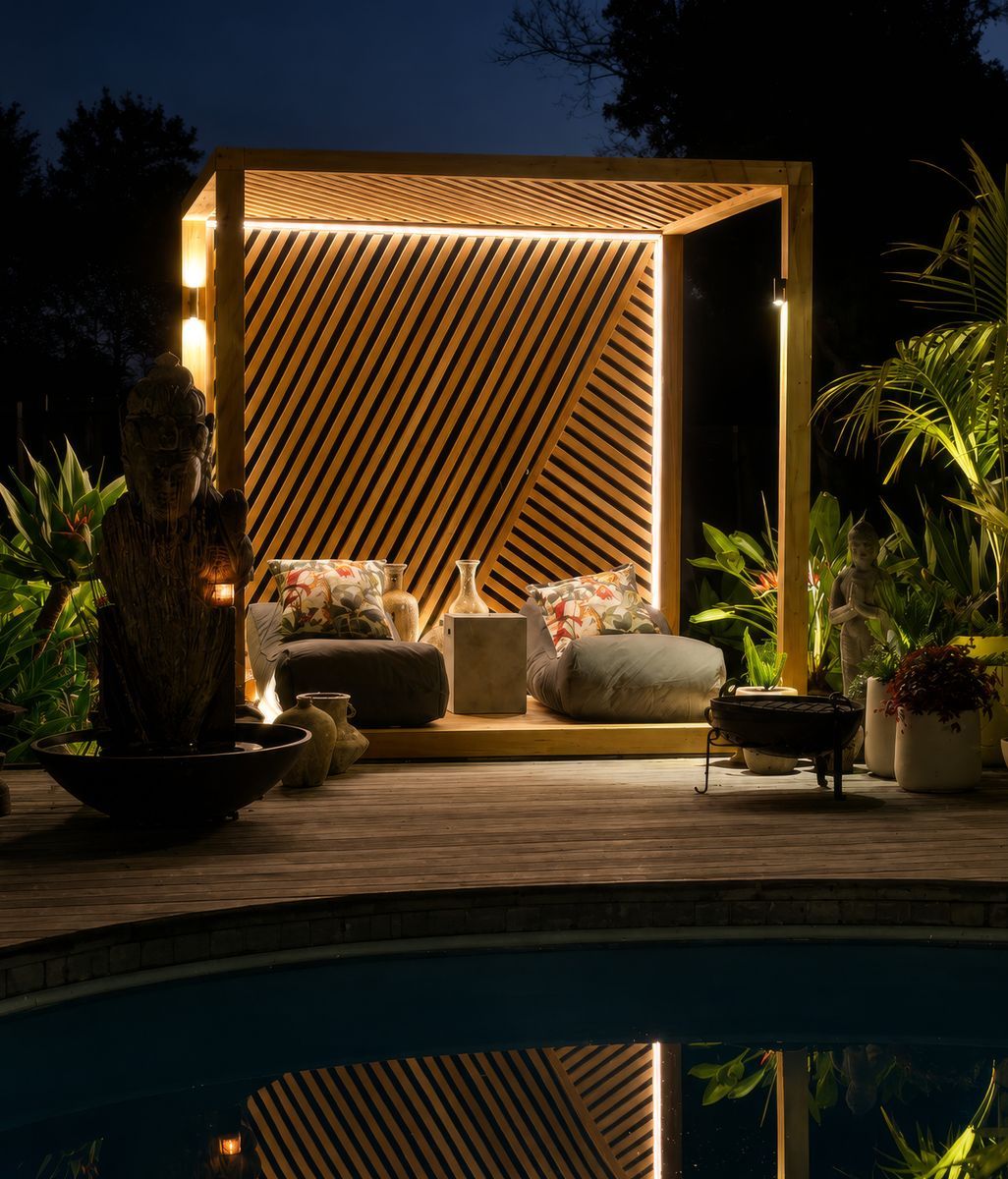
This sensibility runs through Bover's work, shaping lighting that feels integrated into daily life rather than set apart from it. In Australia, where outdoor spaces function as true extensions of the home, this approach feels particularly relevant, with lighting playing a decisive role in whether those environments feel comfortable or exposed.
"In Australia and in the Mediterranean, we share a slower rhythm," Joana says. "Whether it's a plaza in Barcelona or a porch in Byron Bay, the aim is to create oases of calm where people can disconnect."
This is why Bover's products are often perceived not as imported objects, but as tools that understand how people want to live.
"Bover products aren't just physical objects," Joana explains. "They're also a system of aesthetic and functional values."


Comfort is one of those values. Timelessness is another.
"I don't like plastic materials and I don't like fashion trends," she says. "Homes and architecture should be comfortable. Light should accompany us without excess."
Material choices are guided by how they age and how they soften light over time. Natural fibres, woven elements and textiles appear frequently in Bover's work, even in outdoor contexts where technical requirements are strict.
Outdoor lighting presents particular challenges. Regulations demand enclosure and protection, often resulting in fixtures that feel hard or overly technical. Joana's response has been consistent. Meet the requirements, then soften everything around them.
Collections such as Amphora reflect this approach. The waterproof core is necessary, but it is wrapped in woven material that restores warmth and texture. The result is a light that belongs in the landscape during the day as much as it does at night.
More recent collections, including vertical pendants like Yuyun, continue this thinking. New typologies, same intention. Light that feels inhabited rather than installed.
Craft plays a central role in achieving this. Many Bover products involve significant handwork, from weaving shades to assembling components one by one. Small variations are expected and embraced.
"These objects have a soul," Joana says. "There are people behind them. That human touch makes them more authentic."
For Joana, protecting craftsmanship is inseparable from protecting identity.
"A brand is a very sensitive value," she says. "Whoever loses their origin, loses their identity."
When asked what the lighting industry still underestimates, Joana does not talk about technology. She talks about the body.
"I think neuroarchitecture is incredibly important," she says. "Light, colour, materials, proportions, they all influence how we feel, how we behave and how comfortable we are in a space."
"Light is the natural energy my body and mind need in order to feel well," she adds. "It can change my mood, or accompany me in very different ways throughout the day and even through different stages of life."
Lighting, in her view, is foundational. A way of creating refuge and balance within space. When Joana looks to the future, she is less interested in novelty than in understanding. Understanding how people live. How they move. How light supports the nervous system as much as the eye.
Her ambition is simple. To create lighting that improves the experience of space and the quality of daily life.
Explore more products from Bover at Special Lights on ArchiPro.