Warmset vs. Hydronic UFH

Key differences
Warmset
From the ancient Roman hypocausts to today’s hydronic floors, Italy has refined radiant heating for centuries—and Warmset now carries that legacy into the high‑tech era. Our ultra‑thin, far‑infrared electric mat delivers the comfort and efficiency of water‑based underfloor heating yet responds in minutes, installs with millimetres to spare, and runs maintenance‑free, all while letting you heat precisely where and when you need it. Explore the comparison below to see how Warmset turns timeless warmth into smart, modern living.
Hydronic UFH
Hydronic underfloor heating remains a niche solution in Australia. This solution, however, comes with layers of cost and complexity. To name one, as outdoor temperatures edge below about 5 °C, a heat pump’s efficiency drops sharply, and once the mercury slips past 0 °C many systems need backup resistance heaters to keep water temperatures up. That decline in performance lengthens warm‑up times, drives up running costs, and makes day‑to‑day operation more demanding—particularly in regions where winter nights regularly dip into the cold.
Core Heating Concept
- Warmset: Immediate far-infrared heating via a 3mm thick - 17mm wide, flat electric heating ribbon.
- Hydronic: Water must be circulated through 20mm wide pipes, which then release heat via convection.
Heating Element
- Warmset: The distance between heating ribbons is between 3 - 8 cm, guaranteeing evenly spread heat across the whole area.
- Hyrdonic: Water pipes are usually spaced at around 20-22cm intervals, which can create floor temperature variations, leading to cold spots between pipes.
Energy Efficiency
Warmset:
- Warmset’s direct electric heating provides a true 1:1 energy-to-heat conversion, ensuring quick warmth, minimal energy losses, and system simplicity.
- Warmset requires considerably less time to reach the target room temperature, while working gently between 22°C and 35°C maximum. This implies reduced electricty consumption because there are no major temperature spikes.
- Warmset's works consistently as long as there is electricity, its performance is not affected by external temperatures.
- Warmset delivers consistent, predictable heating performance, independent of outdoor temperatures.
Hydronic:
- Involves 3:1 energy-to-heat conversion — heat extraction, water distribution, and floor transfer — each introducing complexity, potential energy losses, and slower system response.
- Considerably slower at reaching target temperature, requires water to be heated at temperatures between 50 - 70 °C.
- A modern, latest generation heat pump can be quite efficient, but below about +5°C, the efficiency drops significantly. Below 0°C, heat pumps struggle and often require backup electric heating. This reduced performance increases running costs, extends heat-up times, and complicates system operation,
System Design
- Warmset: Your Warmset system is designed by our expert technical team in Italy and installation mapping is supplied for your convenience. Instead of relying on a single long heating element, the system is subdivided into multiple independent heating mats. In the highly unlikely event of damage, only the affected mat needs to be repaired or replaced, while the rest of the system remains fully operational.
- Hydronic: The design and installation of an hydronic system is complex, relying on very long continuous pipe loops (typically 150–200 metres). In the event of damage or malfunction (which does happen), the entire connected area can be affected, resulting in a complete loss of heating.
System Zoning
- Warmset: One of the most important ways to optimise your heating bill is to heat a space only when you need it. Through the use of modern temperature control and modulation, zoning with Warmset can be applied to every room. This means that every room will be set up to heat up only when you need it based on your preferences and lifestyle.
- Hyrdonic: An average home with an hydronic system is usually divided into two main thermo-regulated zones. Any additional zoning must be done manually through the various valves in the manifold. This requires a certain level of technical expertise and can be impractical.
Floor Build-Up and Adaptability
- Warmset: Thanks to its thin mats, minimal impact on floor height, fantastic for retrofits. Highly flexible — ideal for small, medium, or large projects, new builds or retrofits.
- Hydronic: Needs thicker screeds and floor buildup to house pipes, greatly limiting retrofit opportunities. Best suited to large new builds; challenging and expensive for small areas or retrofits.
Wattage
- Warmset: In Australia, where home insulation levels are lower compared to Europe, we normally install systems from 60W-100W/sqm. However the system runs for shorter periods, heats faster, and directly delivers heat to occupants, making it more efficient in real use, especially in "on-off" residential patterns.
- Hydronic: Hydronic systems may run at 75-110W/sqm, but need to run much longer to "soak" the slab with enough heat — energy is spread out over time, but it’s less responsive and less targeted. In order to maintain the ambient temperature, the system must continue to work (to maintain the wate at the required temperature).
EMF and DE Emission
- Warmset: Certified by Nemko to be zero EMF. Warmset does not produce any Dirty Electricity and is not affected by the main home cabling (which produces DE).
- Hydronic: Hydronic heating systems may produce very low levels of EMF and small amounts of dirty electricity, mainly localized around their mechanical pumps and controllers.
Origin and Traceability
- Warmset: Warmset mats are 100% made in our factory in Italy. Every single mat is tested and tagged at the origin, deresking to near-zero the chance of receiving a faulty mat. Blockchain technology allows us to trace the entire lifecycle of the mat from raw material to finished product.
- Hydronic: Hydronic systems are typically assembled from a variety of components sourced from different suppliers, often originating from China. This fragmented approach makes it more difficult to accurately assess the overall quality, reliability, and long-term performance of the entire system.
Warranty
- Warmset: Warmset Gold comes with a lifetime warranty (the life of the floor first istalled on the system).
- Hydronic: Hydronic systems have different warranties based on the components. Heat pumps, the "heart of the system", usually come with only a 5-year warranty and require replacement every 10-12 years.
Maintenance
- Warmset: Warmset requires no annual maintenance of routine replacement.
- Hydronic: Annual inspection and maintenance is required. In addition, key parts such as the heat pump, must be replaced eventually.
Space and aesthetic
- Warmset: Once installed under the floor, you'll never see it again!
- Hydronic: Both the heat pump and manifold occupy space and can be unsigthly.
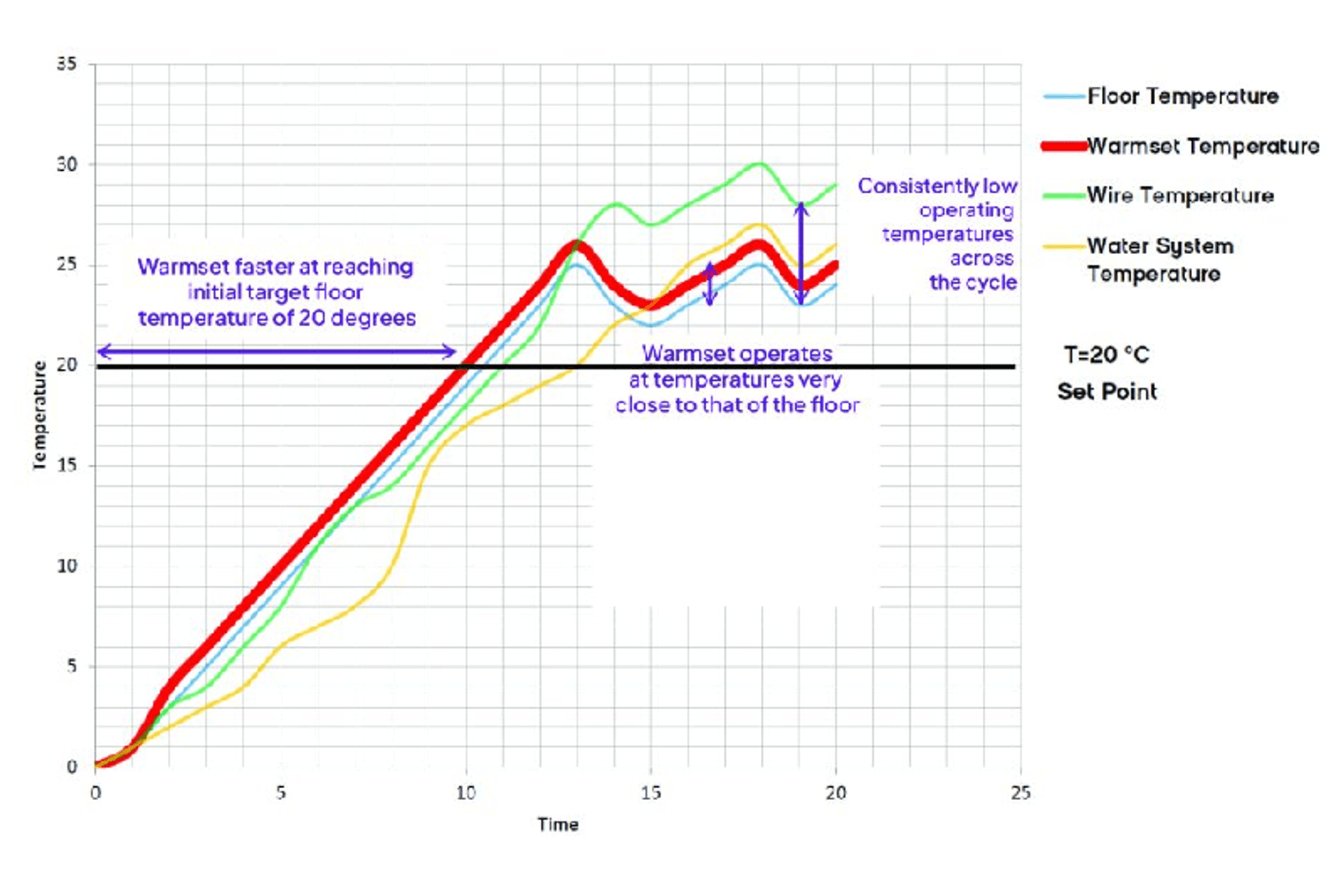
Ongoing Operating Temperatures
In this graph, we compare the speed and operating temperatures of Warmset, electric cable and hydronic underfloor heating. Warmset's powerful FIR reach the target floor temperature of 20 degrees 10% faster than the electric cable and 30% faster than hydronic coils. Warmset continues to operate at gentle temperatures, similar to hydronic (in fact 1 degree lower). Bottom line: Warmset can be compared to the gentleness of hdyronic while operating, but at the speed of an electric system.